www.theatlantic.com
Boeing 747: the engineering gamble that built the wide-body age
A ~5,000-word engineering teardown of the Boeing 747 — the world's first wide-body jet airliner. Traces the constraint→solution→cost chain from the 1964 CX-HLS military loss (which produced the hump and nose cargo door) through Juan Trippe's 2.5× capacity brief, the JT9D ovalization crisis, the Everett factory built before the plane was designed, the 37.5° wing and 16-wheel landing gear, to six variants across 54 years and the three design decisions that permanently reshaped aviation: twin-aisle cabin, nose cargo door, high-bypass turbofan.

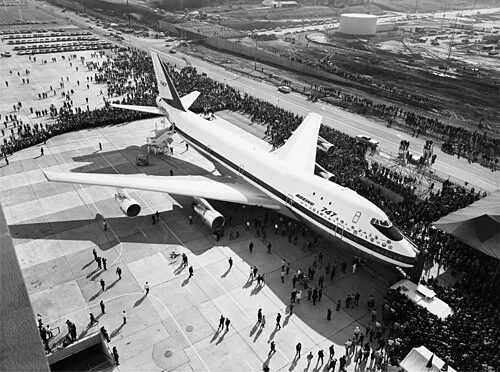
On September 30, 1968, 26,000 Boeing employees and their families crowded the freshly completed assembly building at Paine Field, Everett, Washington, to watch a 231-foot airplane roll out of a factory that had been built specifically to contain it — before the airplane's design was finished. The prototype Boeing 747, registration N7470, was so large that the structure housing it was at that moment the highest-volume building on Earth. Boeing president William M. Allen watched the ceremony and reportedly said afterward: "It was really too large a project for us." 1
Allen was not being modest. He was describing, in the flat language of a man who had survived it, a decision that had come closer to destroying his company than any competitor ever had.
The brief that broke every rule
The requirement that produced the 747 traces back not to Boeing, but to Pan American World Airways (Pan Am) president Juan Trippe — and to a military contract Boeing lost.
In 1964, the U.S. Air Force issued the CX-HLS (Cargo Experimental, Heavy Logistics System) request for proposals: a strategic airlifter capable of carrying 125,000 lb of military cargo over intercontinental ranges. All three competing designs — from Boeing, Douglas, and Lockheed — shared a structural constraint imposed by the requirement to load cargo through the nose. The nose cargo door meant the cockpit had to move; every competitor pushed the cockpit up above the main cargo deck and behind the nose. Boeing's proposal extended this elevated cockpit into a long upper-lobe that ran from the nose back past the wing. Lockheed's design (which won the competition as the C-5 Galaxy) used a comparable solution. 1
Boeing lost. But the company had spent two years solving a particular geometry problem — how to make a very large fuselage loadable through its nose while keeping the flight deck accessible — and Joe Sutter, the engineer Boeing assigned to study a possible wide-body commercial aircraft in 1965, recognized that the solution applied directly to the airline market.
The commercial requirement came from Juan Trippe. In 1965, Pan Am was operating Boeing 707s on its transatlantic routes and watching airport congestion grow faster than anyone's gate-expansion plans. Trippe wanted an airplane roughly 2.5 times the passenger capacity of the 707, with a corresponding reduction in cost per seat. The number he put on it: a new jetliner able to carry 490 passengers in high-density configuration at a per-seat cost 30% lower than the 707. 1
In April 1966, Pan Am signed a letter of intent for 25 aircraft at a total value of $525 million — equivalent to roughly $3.9 billion in 2024 — making the airline the program's launch customer before a single production drawing had been issued. 1 At the contract signing dinner marking Boeing's 50th anniversary, Trippe told the assembled crowd that the new aircraft would be "a great weapon for peace, competing with intercontinental missiles for mankind's destiny." 1 This was not rhetoric. Trippe genuinely believed that making air travel cheap enough for working-class passengers would change geopolitics.
Boeing had 28 months to deliver the first aircraft to Pan Am. A conventional new-aircraft program took twice that.
Why not a double-decker?
The first question Sutter's design team had to answer was not "how wide?" but "how many floors?"
A full double-deck layout — lower deck carrying eight seats across, upper deck carrying seven — was analyzed seriously and rejected. The reasons were structural and operational, not aesthetic. Evacuation certification for a 500-seat aircraft requires the plane to be emptied through half its exits in 90 seconds, per FAA regulations. A two-floor cabin doubles the evacuation path complexity, requires two independent systems of emergency slides, and adds structural weight in the inter-deck floor beams and vertical connections. For a wide single-deck cabin, the exits are at floor level; for a double-decker, the upper exits discharge passengers 20 feet above the tarmac. 1
The design team also recognized that a full double-deck aircraft would be difficult to convert to a freighter. Pan Am's requirement included the assumption that when supersonic commercial aviation arrived — Boeing was simultaneously developing the SST 2707, its answer to Concorde — the 747 would be obsolete as a passenger carrier within a decade and would need a second life as a freighter. A full-double-deck fuselage with its inter-deck floors and upper-lobe windows was nearly impossible to strip and re-purpose for cargo. 2
The solution Sutter's team settled on was a wide single main deck with a raised flight deck. Main cabin internal width: 6.10 m (240 in), sufficient for a 3-4-3 economy configuration with two aisles. This was the first twin-aisle passenger cabin in aviation. The external fuselage diameter is 6.50 m (256 in). 1
The crucial insight — which Sutter later credited to the geometry of standard air-freight containers — was that a 6.10 m internal width permits two standard 8 ft × 8 ft (2.44 m × 2.44 m) air freight containers to sit side-by-side on the main deck when the seats are removed. The 747's cross-section was designed from the outset to support a freighter conversion that no one was yet sure would be necessary. That decision, made in 1966, is the reason UPS and FedEx still flew 747 freighters into the 2020s. 2
The hump: a cargo door in disguise
With the main cabin floor established and the twin-aisle layout fixed, the flight deck position followed directly from the CX-HLS geometry that Boeing had developed for the C-5 competition. Moving cargo through the nose of a freighter version meant the flight deck could not be at the front of the main cabin level — it had to be above it.
The Boeing team raised the cockpit 2 ft 7 in (0.79 m) above the main cabin floor and extended a short upper lobe behind it. This produced the 747's distinctive bulge, universally known as "the hump." In the initial passenger configuration, the space behind the cockpit was designated a first-class lounge — the Pan Am Clipper Club, with spiral staircase access from the main cabin. 1
The hump was therefore a structural consequence of three things stacked together: the nose cargo door requirement (from the military CX-HLS concept), the evacuation safety constraint (which ruled out full double-deck), and the freighter conversion goal (which dictated an unobstructed main deck). It was not a design flourish. The price was aerodynamic: a non-circular fuselage cross-section at the nose creates additional wave drag and complicates the pressure vessel design. Boeing's aerodynamicists accepted this penalty because the fuselage stations fore and aft of the hump are circular, and the hump itself is short enough that its contribution to total drag is small at the 747's Mach 0.85 cruise speed. 1
The 747-300 (1983) extended the upper lobe to roughly twice its original length as a standard-production stretched upper deck (SUD), converting the lounge space into 69 additional economy seats or a full upper-deck business-class cabin. This transformation — from cocktail bar to seat rows — was not a design refinement; it was a revenue response to the oil shocks of the 1970s, which made Pan Am's original vision of spacious cabin luxury economically unviable. 1
The engine nobody had yet built
The wide-body cabin was meaningless without an engine that could move it economically. The 747 needed roughly four times the thrust of the 707's Pratt & Whitney JT3D — not from four larger conventional turbojets, but from a fundamentally different engine architecture.
The relevant breakthrough was the high-bypass turbofan. In a conventional turbojet, all ingested air passes through the combustion chamber. In a high-bypass turbofan, a large-diameter front fan moves a much larger mass of air, of which only a fraction enters the core for combustion; the rest passes around the engine as a "bypass" flow that produces thrust with far less fuel burn. The bypass ratio — the mass ratio of bypass air to core air — measures how far the design moves from turbojet toward bypass efficiency. The JT3D powering the 707 had a bypass ratio of approximately 1.4:1. 3
Pratt & Whitney's JT9D, developed specifically for the 747 beginning in September 1965, targeted a bypass ratio of 4.8:1 with an initial thrust of 43,500 lbf (193 kN). The fan diameter was 93.4 in (2.37 m) — wider than the fuselage of many earlier jet aircraft. 3 The thermodynamic result: thrust approximately doubled relative to the JT3D while specific fuel consumption dropped by roughly one-third. This was the number that made Trippe's per-seat cost target achievable. A 747 with turbojets would have burned fuel at a rate that negated the capacity advantage.
The JT9D program was simultaneously General Electric's opportunity and Pratt & Whitney's gamble. GE had already developed the TF39 high-bypass engine for the C-5 Galaxy — technically, GE had the proof-of-concept hardware first. But GE's military focus left the commercial wide-body market open, and P&W moved to fill it alongside Boeing and Pan Am. 4
The JT9D's early service history nearly killed the 747 program. During flight testing in 1968 and into 1970, the engine exhibited two failure modes that ground fleets:
First, rapid throttle advance caused the compressor to stall — an operationally unacceptable behavior during takeoff go-arounds, the exact moment maximum thrust is required. The root cause was the mismatch between the large fan's inertia and the compressor bleed scheduling at high power.
Second, and more structurally serious: the engine casing ovalized under the mechanical stresses of takeoff power. The JT9D's turbine section, running at 43,500 lbf thrust, generated loads that deformed the high-pressure turbine casing from a circle to a slight ellipse. This reduced the clearance between rotating blade tips and the casing to zero, causing blade-tip rub, rapid wear, and in some cases blade contact with the casing. 3
The consequence: in 1969 and early 1970, as many as 20 assembled 747s sat on the Everett ramp waiting for serviceable engines. Boeing was paying interest on $1.2 billion in bank debt and could not deliver the aircraft that would generate revenue to service it. The fix — casing reinforcement and a forked thrust link that redistributed the takeoff load — arrived in time to prevent program cancellation, but the episode demonstrated how completely the three-way dependency (airframe/engine/factory) had locked Boeing into a single point of failure.
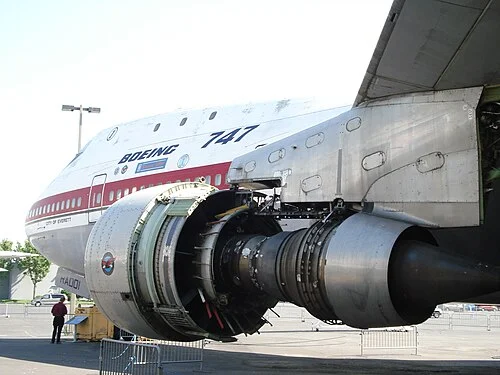
The JT9D stabilized into a production engine and was developed through multiple variants, reaching 56,000 lbf (249 kN) in the JT9D-7R4H1 before P&W's PW4000 replaced it on the 747-400. GE entered the 747 market with the CF6-50 for the -200 and -300 variants — a derivative of the C-5's TF39, with a bypass ratio of approximately 4.3 and thrust up to 54,000 lbf (240 kN). 4
Rolls-Royce's entry into the 747 engine market came through the RB211, the world's first three-spool (three independent rotating shafts) production turbofan, developed for the Lockheed L-1011 TriStar. The RB211-524 series powered 747-200 and -300 variants for airlines including British Airways and Qantas. Qantas found the RB211-equipped 747s burned roughly 7% less fuel than their JT9D fleet — a saving of approximately $1 million per aircraft per year at 1980 fuel prices. 5
The RB211 program had its own near-death experience, more severe than the JT9D's ovalization: Rolls-Royce had specified Hyfil, a carbon-fiber composite material, for the fan blades — lighter than titanium, but vulnerable. In bird-strike testing, the Hyfil blades shattered catastrophically. Rolls-Royce had to fall back to titanium fan blades, which added weight and development cost. Development costs doubled to £170.3 million, and on February 4, 1971, Rolls-Royce filed for insolvency. The Edward Heath government nationalized the company to preserve the engine program and 80,000 engineering jobs. 5 The three-spool architecture Rolls-Royce salvaged from that crisis is now the foundation of the Trent engine family powering the Boeing 777, 787, Airbus A350, and A380.
The factory built before the plane was designed
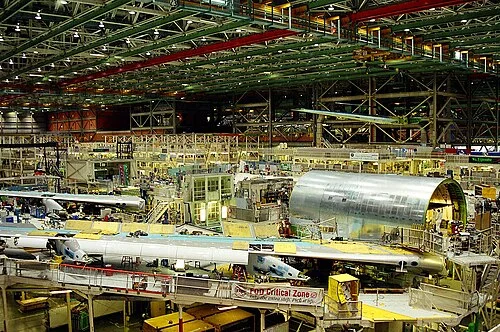
Boeing did not have a building large enough to assemble the 747. In early 1966, with Pan Am's letter of intent signed and the program clock running, Boeing surveyed approximately 50 candidate sites before selecting a 780-acre parcel at Paine Field, Everett, Washington, 30 miles north of Seattle. 1
The site required moving more than 4 million cubic yards (3 million cubic meters) of earth to create a flat assembly pad. Construction of the factory building — the largest by volume in the world at the time of its completion — began before the 747's aerodynamic design was frozen. In practice, the factory was designed around the aircraft's anticipated dimensions while the aircraft's dimensions were still being argued over.
Boeing's total program development cost exceeded $2 billion, of which $1.2 billion was borrowed from a syndicate of banks. This was, at the time, the largest corporate borrowing in history. 1 The program strained Boeing's cash flow to the point that, during the final months before first delivery, the company was making repeated emergency applications to its bank syndicate for additional credit lines. If the banks had declined — if the JT9D ovalization problem had delayed the first delivery by six months longer than it did — Boeing's auditors would have had a serious question about going concern.
The assembly operation itself was a logistics machine of considerable complexity. Boeing distributed subcontract manufacturing across the U.S. aerospace sector: Northrop and Grumman produced fuselage sections and trailing-edge flaps; Fairchild made the tail-section control surfaces; Vought (LTV) built the tail assembly. Major components traveled by road and rail to Everett for final joining. 1
The workforce Boeing assembled for the program was called, internally, "The Incredibles" — a reference to the compressed timeline that required 4,500 engineers, led by Joe Sutter, to produce an aircraft design that would normally take five years in under 29 months. 6
Wing, landing gear, and the high-lift system
The 747's wing is a 37.5°-swept trapezoidal surface with a span of 195 ft 8 in (59.64 m) on the -100 variant. The sweep angle was chosen to achieve a cruise Mach number of 0.85 (490 kt; 900 km/h) while keeping the wing structurally practical — higher sweep reduces transonic wave drag but increases structural depth requirements and introduces aileron reversal problems at high speed. 37.5° is the engineering compromise between aerodynamic efficiency and structural weight. 1
The secondary benefit of the 37.5° sweep was dimensional: it reduced the projected wing span enough that the 747 could use existing wide-body terminal gates at major international airports without forcing a complete ramp infrastructure rebuild.
The high-lift system is more sophisticated than any commercial aircraft that preceded it. The trailing edge carries triple-slotted Fowler flaps across most of the span — three separate flap elements that deploy sequentially to increase wing camber and chord simultaneously. At full flap extension, wing area increases by 21% and lift by 90% relative to the clean cruise configuration. 1 The leading edge carries Krueger flaps for almost its full length. This high-lift system was required because the 747's wing, optimized for Mach 0.85 cruise, is relatively thin and has low camber — characteristics that produce low lift at the low speeds required for approach and landing at existing runway lengths.
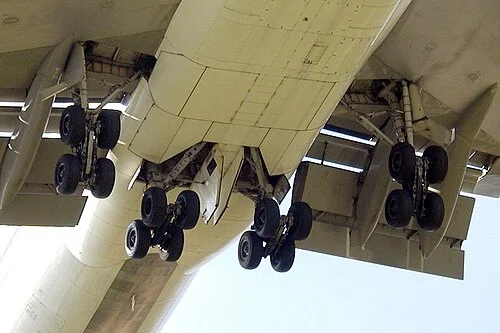
The landing gear configuration was unprecedented for a commercial aircraft. Four main gear bogies, each carrying four wheels, provide 16 main wheels total; a two-wheel nose gear brings the wheel count to 18. 1 The four-bogie main gear arrangement distributes the aircraft's weight across a wider footprint than the two-bogie systems of earlier jets, keeping the pavement loading within limits that existing airport aprons could accept. Without this distribution, the 747 would have required runway and taxiway reconstruction at every airport it served.
Flight testing in 1969 revealed two significant structural problems:
Wing flutter — oscillatory vibration that, at certain speeds and altitudes, can amplify to structural failure — was found during high-speed flight test. The primary fix was reducing the stiffness of specific wing skin panels (counterintuitively, softening selected structure changes the flutter frequency out of resonance with the driving aerodynamic force). A secondary fix was more unusual: depleted uranium ballast weights were installed inside the outboard engine nacelles to shift the wing's mass distribution and change its flutter mode. Depleted uranium was selected for its extremely high density — roughly twice that of lead — which provided the required mass in a compact volume that a conventional steel counterweight could not match. 1
Dutch roll susceptibility — a coupled rolling and yawing oscillation that afflicts swept-wing aircraft and was a serious handling problem for early 707s — was investigated thoroughly during 747 flight testing. The aircraft was found to be substantially resistant to Dutch roll, a consequence of its high aspect-ratio wing geometry and the large vertical tail. This was an engineering success, not a solved problem: the 747 simply happened to fall in a parameter space where the tendency was benign.
The 747's structural design employed fault tree analysis (FTA) — then a relatively new method, developed by Bell Telephone Laboratories and formalized by Boeing for the Minuteman missile program — to map the consequences of single-component failures through the full system. This produced the redundancy architecture: four independent hydraulic systems, four main gear bogies (any two of which are sufficient to land safely), and dual control surfaces. 1
Technical specifications
| Parameter | 747-100 | 747-400 | 747-8 |
|---|---|---|---|
| First delivery | 1970 | 1989 | 2011 |
| MTOW | 735,000 lb (333 t) | 875,000 lb (397 t) | 975,000 lb (442 t) |
| Max range | 4,620 nmi (8,560 km) | 7,325 nmi (13,570 km) | 8,000 nmi (14,820 km) |
| Typical passenger capacity | 366 (3-class) | 416 (3-class) | 467 (3-class) |
| Engine (primary) | P&W JT9D-3A | P&W PW4056 / GE CF6-80C2 / RR RB211-524 | GE GEnx-2B67 |
| Sea-level thrust (per engine) | 43,500 lbf (193 kN) | 56,750–63,300 lbf (252–282 kN) | 66,500 lbf (296 kN) |
| Fuselage length | 231 ft 10 in (70.66 m) | 231 ft 10 in (70.66 m) | 250 ft 2 in (76.25 m) |
| Wingspan | 195 ft 8 in (59.64 m) | 211 ft 5 in (64.44 m) | 224 ft 7 in (68.40 m) |
| Cruise speed | Mach 0.84 | Mach 0.85 | Mach 0.855 |
| Service ceiling | 45,100 ft | 45,100 ft | 43,100 ft |
Specifications above cover the three primary production variants; MTOW and range figures reflect the maximum-weight sub-variant of each generation. 1 7
First flight and entry into service
On February 9, 1969, at 11:34 local time, the prototype N7470 lifted off from Paine Field with test pilot Jack Waddell at the controls, co-pilot Brien Wygle, and flight engineer Jess Wallick. The flight lasted 1 hour and 16 minutes. 1
There was a flap problem. During the final approach, one of the trailing-edge flap sections did not retract fully to the landing setting, causing an asymmetric lift condition that Waddell managed by holding a bank angle throughout the approach. After landing, Boeing engineers diagnosed a flap jackscrew binding — a relatively minor mechanical fault that was corrected within days. The flight data were otherwise exemplary: handling characteristics matched predictions, and the aircraft showed no tendency toward Dutch roll or uncommanded pitch oscillation.
Five months after that flight — on July 20, 1969 — Neil Armstrong and Buzz Aldrin landed on the Moon. The coincidence of timelines is not incidental: both programs were products of the same decade of American industrial and engineering capacity operating under maximum pressure. Both were bets placed before the technology existed to guarantee the outcome.
The FAA issued the 747's type certificate on December 30, 1969. Pan Am's first commercial service — Flight 2, New York JFK to London Heathrow — operated on January 22, 1970. The aircraft carried 332 passengers. The age of mass long-haul travel, in the sense that Trippe had imagined it, began that evening. 1
Six generations across 54 years
The 747's production lifespan of 54 years — 1968 to 2023 — produced six primary variants and numerous subvariants, with each generation tracing directly back to a specific market or operational constraint that the previous version could not satisfy.

The 747-100 (167 aircraft) established the baseline. The 747-200 (393 aircraft, including sub-variants) responded to airline demand for more range — the maximum takeoff weight grew from 735,000 lb to 833,000 lb (378 t) and the design range extended from 4,620 to 6,560 nmi. 1
The 747SP (Special Performance, 45 aircraft, 1976) was a deliberate shrink: the fuselage was cut by 47 ft (14.3 m), reducing passenger capacity to allow a higher-altitude cruise (service ceiling 45,100 ft) and ultra-long-range performance on routes like New York–Tehran and New York–Tokyo nonstop. Pan Am and Iran Air were the launch customers. 8 Boeing projected sales of 200 aircraft; 45 were built. The SP is the clearest example of a variant that solved a specific problem — ultra-long-range, low-density routes — but that the market was not large enough to support.
The 747-400 (694 aircraft, 1989) is the commercial cornerstone. Its glass cockpit — replacing the three-crew arrangement (two pilots plus a flight engineer monitoring engine instruments) with a two-crew EFIS (Electronic Flight Instrument System) cockpit and FADEC (Full Authority Digital Engine Control) — eliminated the third crew seat and reduced operating costs by one crewmember per flight. Boeing added 6-foot winglets (winglet extension of 17 ft to the span) that reduced induced drag by approximately 3%, improving fuel economy and enabling the -400's 7,325 nmi range. 9
Lufthansa vice president Reinhardt Abraham, quoted in Aviation Week in 1984, had pressed Boeing publicly for a comprehensive upgrade rather than incremental changes: "We don't like the piecemeal approach. We want one full package on the airplane. It would be a big incentive for new orders." 9 The 747-400 was Boeing's response to that pressure — and at 694 deliveries, it became the most widely built variant.
The 747-8 (155 aircraft, 2011–2023) stretched the fuselage by 18.3 ft (5.6 m) to 250 ft 2 in (76.25 m), making it the longest commercial aircraft currently in service. It introduced the GEnx-2B67 engine — derived from the same GEnx core that powers the 787 — with distinctive serrated "chevron" exhaust nozzles that reduce jet noise by disrupting the mixing layer at the core/bypass flow boundary. The 747-8 also introduced partial fly-by-wire flight controls, replacing the direct cable connections on some surfaces with electrical signaling. 7 Of the 155 aircraft built, 107 were freighters and 48 were passenger variants — a ratio that reflects the fundamental shift in the 747's market position by the 2010s: airlines were replacing passenger 747s with the Boeing 777-300ER and Airbus A350, while freight operators continued to value the 747's main-deck capacity and nose-door capability.
The final 747 — a 747-8F for Atlas Air, registration N863GT — was delivered on January 31, 2023, with a fuselage sticker reading "Forever Incredible" in tribute to Joe Sutter. Total production: 1,574 aircraft across 54 years. 1
Legacy: what the 747 changed permanently
The 747's engineering consequences operate at four levels, each traceable to a specific design decision made between 1965 and 1969.
The democratization of long-haul travel was Trippe's stated goal and was delivered, though not in the form he anticipated. The 747's introduction drove down transatlantic fares sufficiently that by the mid-1970s, economy-class air travel between the U.S. and Europe was accessible to middle-income passengers who would previously have considered ocean-liner crossings. The specific mechanism was the per-seat cost reduction that Trippe had demanded: at 490 seats per aircraft against a four-engine fuel burn only modestly higher than a 150-seat 707, the seat-mile economics shifted definitively. 1
The wide-body airliner category itself is a direct 747 legacy. The 747 entered service in January 1970; the Douglas DC-10 followed in 1971, the Lockheed L-1011 in 1972. All three used the twin-aisle cabin layout that Sutter's team had established. By end of 2018, more than 9,100 wide-body aircraft had been delivered globally since 1969. 10
The freighter market was a consequence Boeing had designed in from the beginning, and it proved more durable than the passenger market. The 747F's nose cargo door — inherited from the CX-HLS military concept, preserved through the fuselage design decisions of 1966 — allows loading of cargo pallets up to 40 ft (12 m) long and containers that cannot fit through the side doors of narrow-body conversions. FedEx and UPS built their intercontinental freight operations around the 747F from the 1980s onward. As of the mid-2020s, 747 freighters continue to fly as the backbone of express air freight networks, with the 747-8F operating at a maximum payload of approximately 134 t. 1
Government and special-mission applications proliferated from the 747's capabilities. The U.S. Air Force operates VC-25A aircraft — extensively modified 747-200s — as Air Force One. The E-4B "Nightwatch" airborne command posts are 747-200 derivatives kept on continuous 24-hour alert. NASA used two 747s as Shuttle Carrier Aircraft to ferry Space Shuttle orbiters between landing sites and Kennedy Space Center. The SOFIA (Stratospheric Observatory for Infrared Astronomy) was a 747SP modified to carry a 2.5-meter infrared telescope in an open aft fuselage door — flying at 41,000 ft above most of the water vapor that blocks infrared observation from the ground. 1
リンクプレビューを読み込んでいます…
The 747's cultural position was assessed in July 2026 by The Atlantic, where writer Ian Bogost argued the aircraft had been "a symbol of American power, invention, progress, and populism" and that its retirement embodied the decline of those same values. 11 Bogost's 9,000-word report visited the aircraft boneyard at Pinal Airpark in Marana, Arizona, where retired 747s sit in desert storage, and quoted former United Airlines flight attendant Peggy Verger: "We've lost the personality of flying." 11 Whether that personality resided in the aircraft or merely in the era when long-haul travel was new and rare enough to feel like an event is a question the engineering record cannot answer. What the record does answer: the aircraft's design team, operating under a 28-month deadline in 1966, made decisions about fuselage cross-section, landing gear distribution, and engine bypass ratio that remained commercially and operationally viable for more than half a century. The twin-aisle cabin is still the standard for every wide-body aircraft flying today. The nose cargo door concept is still the reason express freight operators can load oversized cargo that no other commercial aircraft can accept. The high-bypass turbofan that Pratt & Whitney scrambled to build for the 747 became the engine architecture for every commercial airliner on Earth.
Joe Sutter, who led the 4,500-person engineering team and was awarded the National Medal of Technology by President Reagan in 1985, was inducted into the National Aviation Hall of Fame in 2024, eight years after his death at age 95. 6 The last 747 delivered bore a sticker memorializing him. The aircraft that Boeing president William Allen called too large a project for his company has, over 54 years of production and service, outlasted the supersonic aircraft it was supposed to precede, the airlines that ordered it, and the engineers who designed it. Allen's assessment of the risk was accurate. His assessment of the outcome was not.
Cover image: Prototype Boeing 747 (N7470) rollout at Everett, Washington, September 30, 1968, before an audience of 26,000 Boeing employees and their families. Image: Wikipedia/Boeing (CC BY-SA).
参考ソース
- 1Wikipedia — Boeing 747
- 2University of Washington Magazine — Joseph Sutter
- 3Wikipedia — Pratt & Whitney JT9D
- 4Wikipedia — General Electric CF6
- 5Wikipedia — Rolls-Royce RB211
- 6Hermes Air Transport — Joe Sutter
- 7Wikipedia — Boeing 747-8
- 8Wikipedia — Boeing 747SP
- 9Wikipedia — Boeing 747-400
- 10Wikipedia — Wide-body aircraft
- 11The Atlantic — The Boeing 747 Begins Its Final Descent
このコンテンツについて、さらに観点や背景を補足しましょう。